 1 / 11
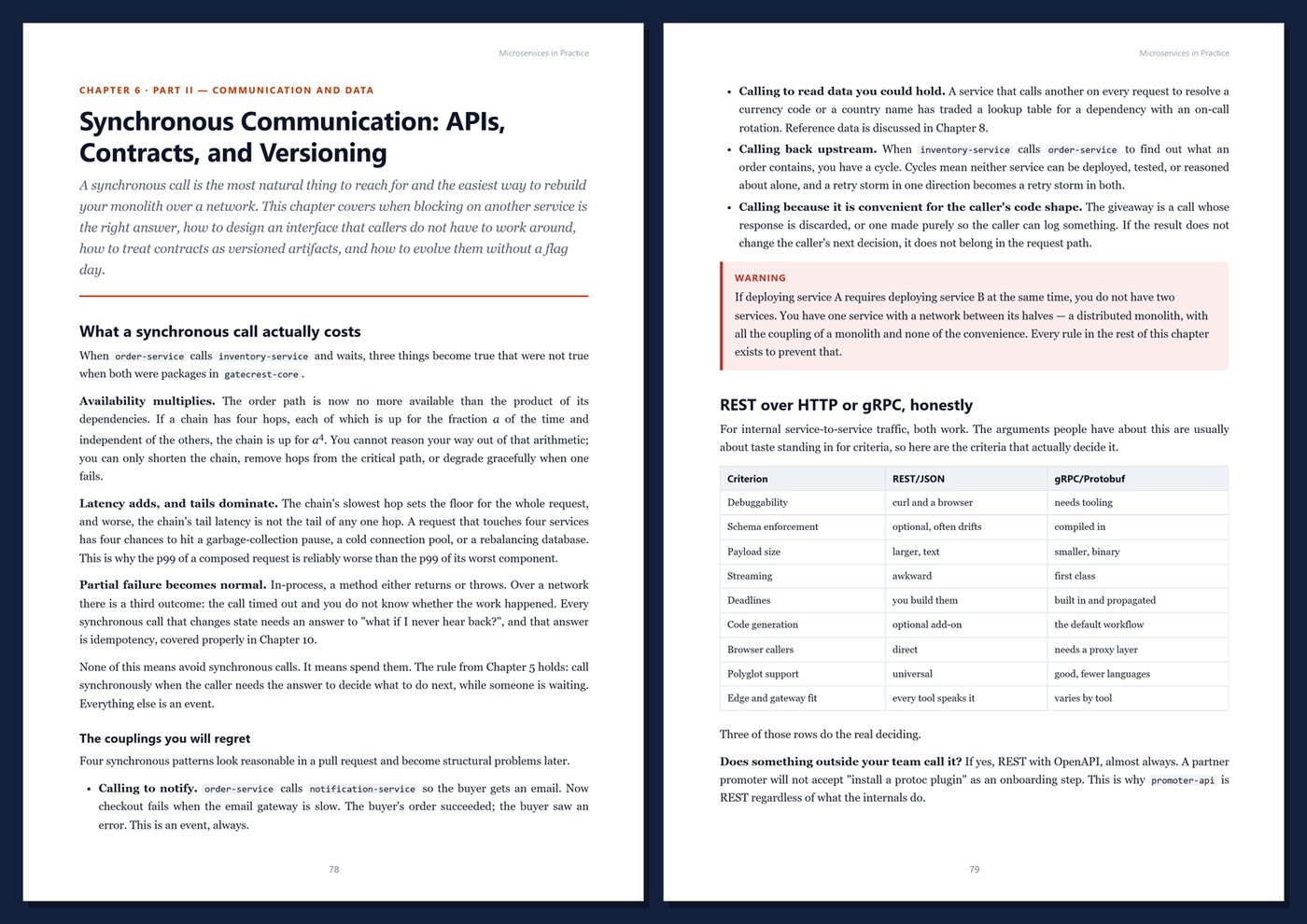
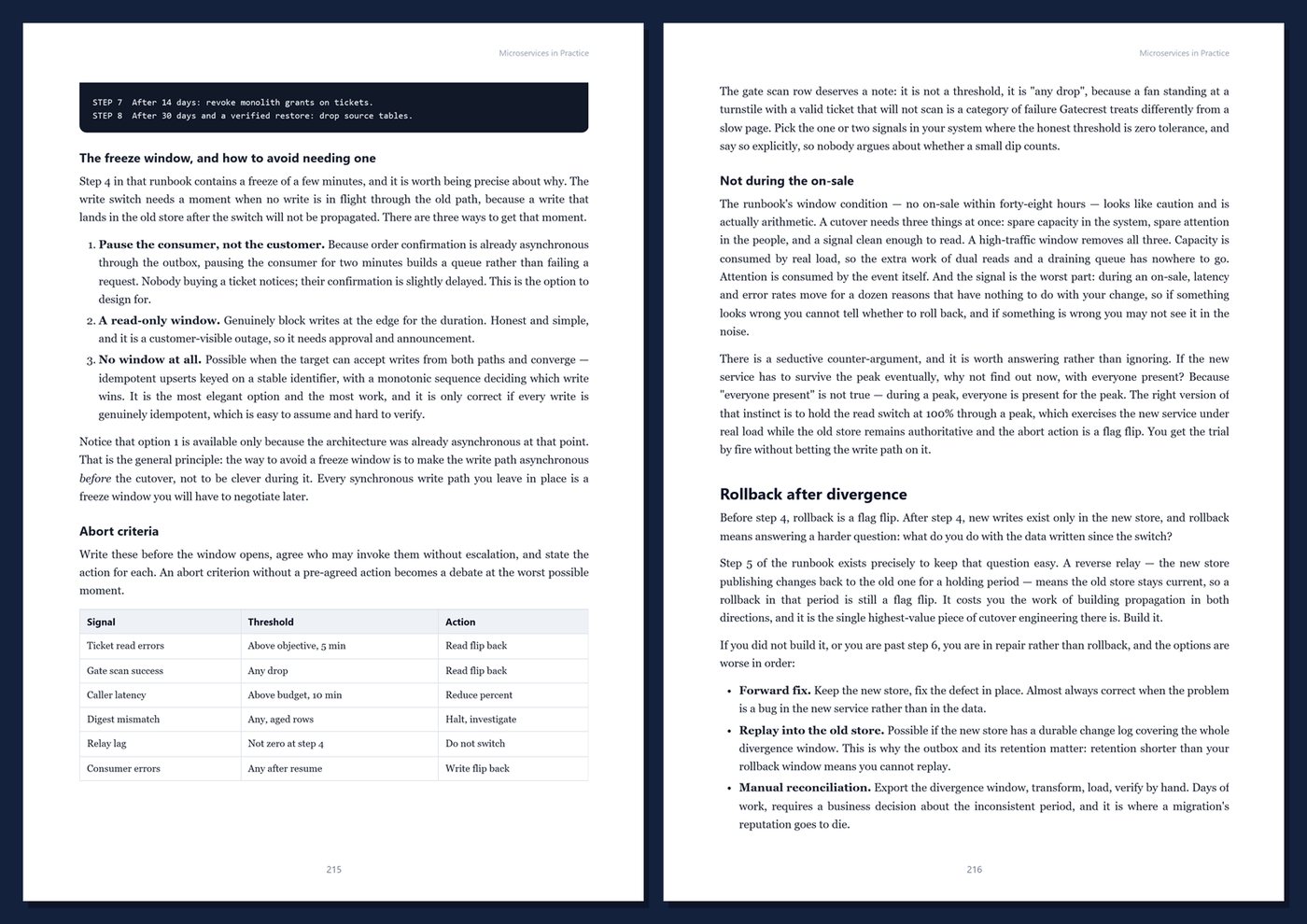
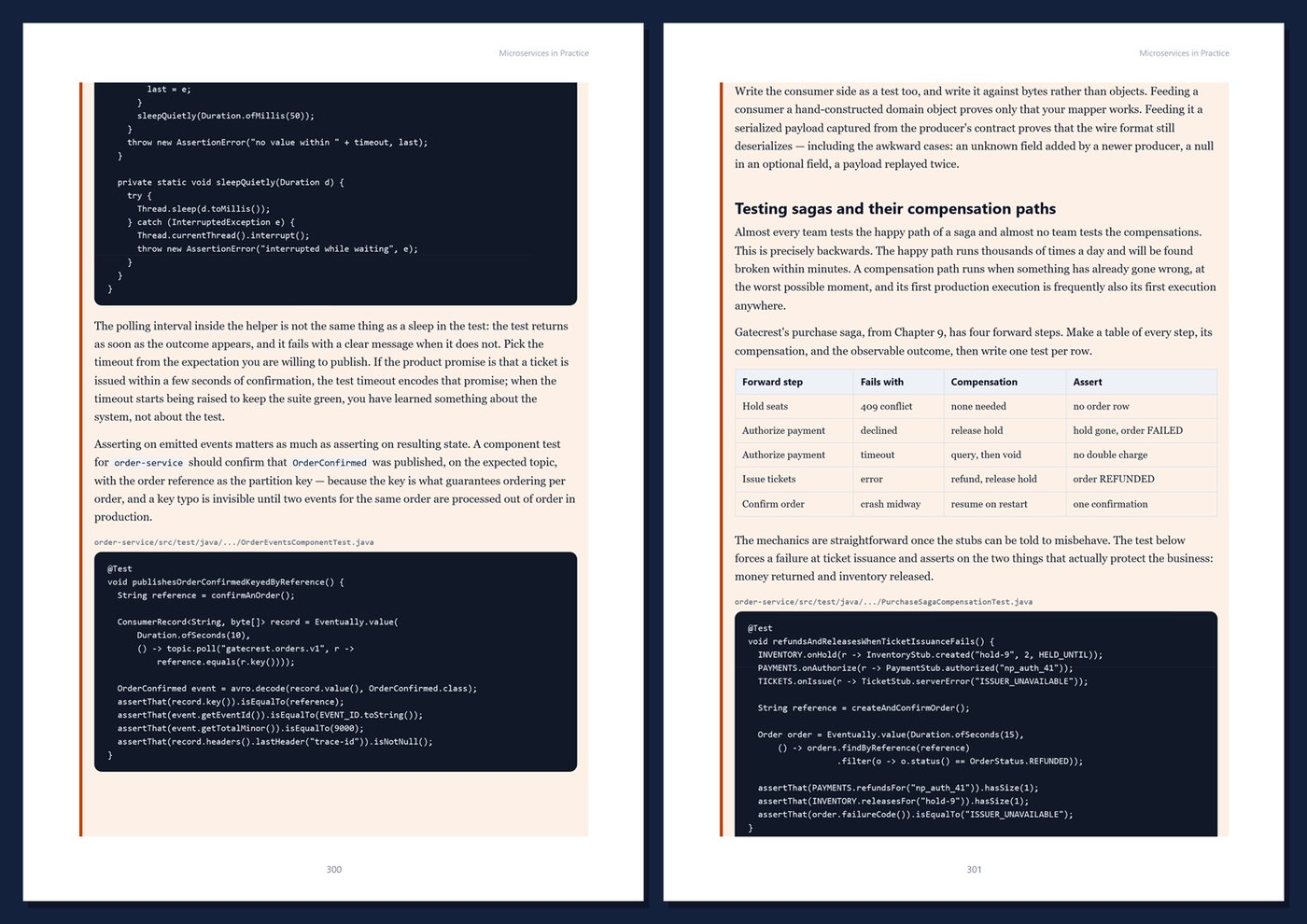
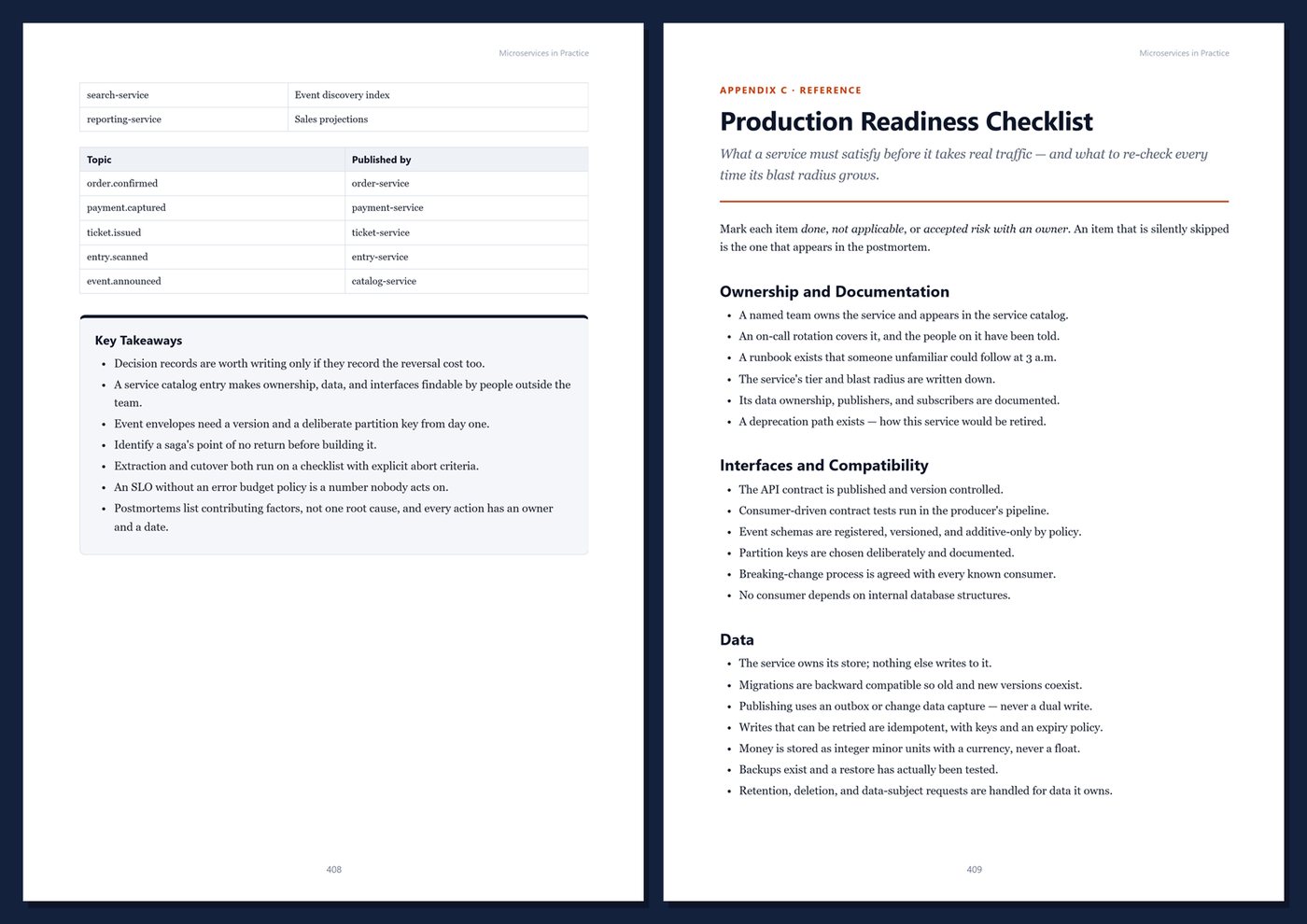
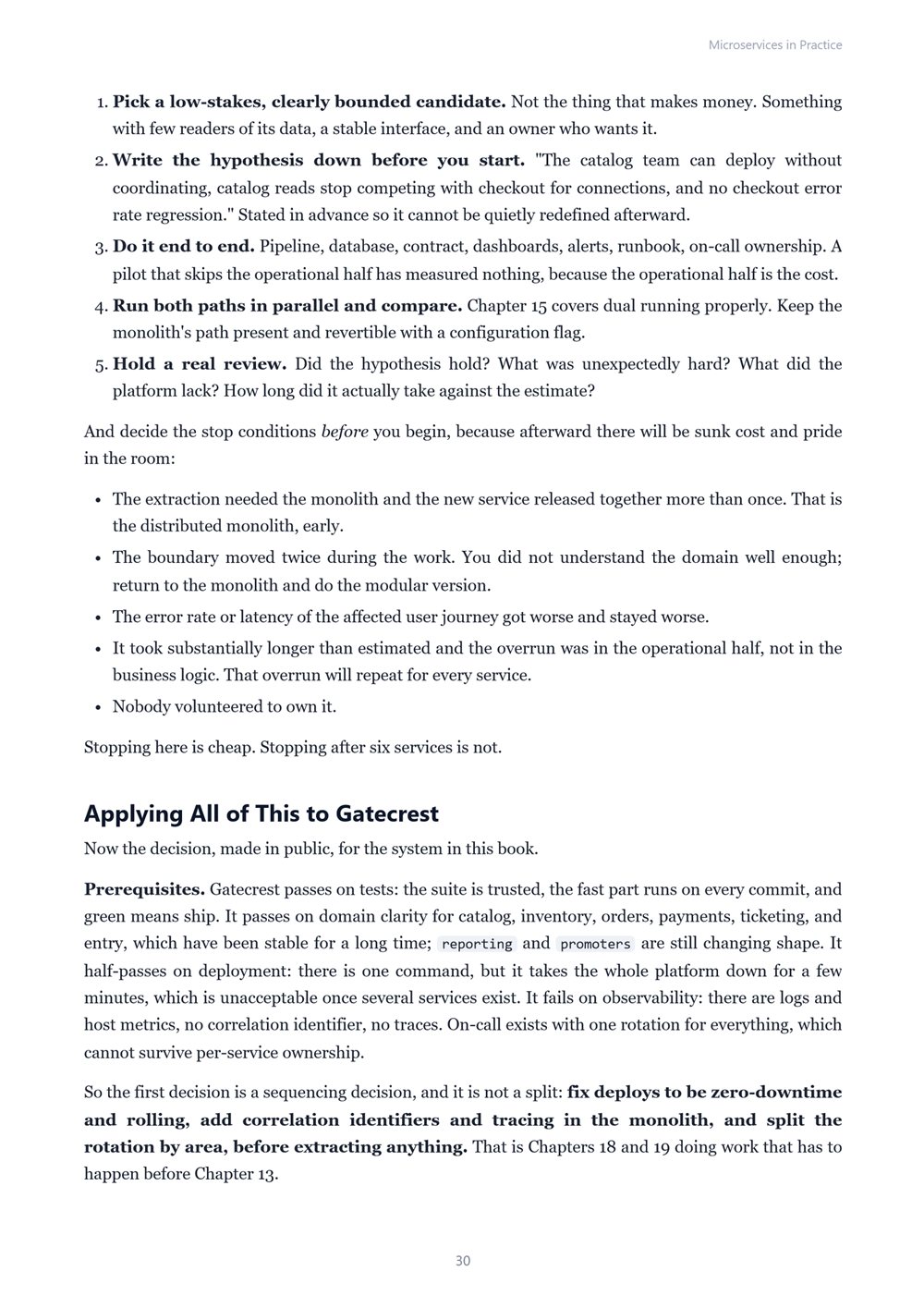
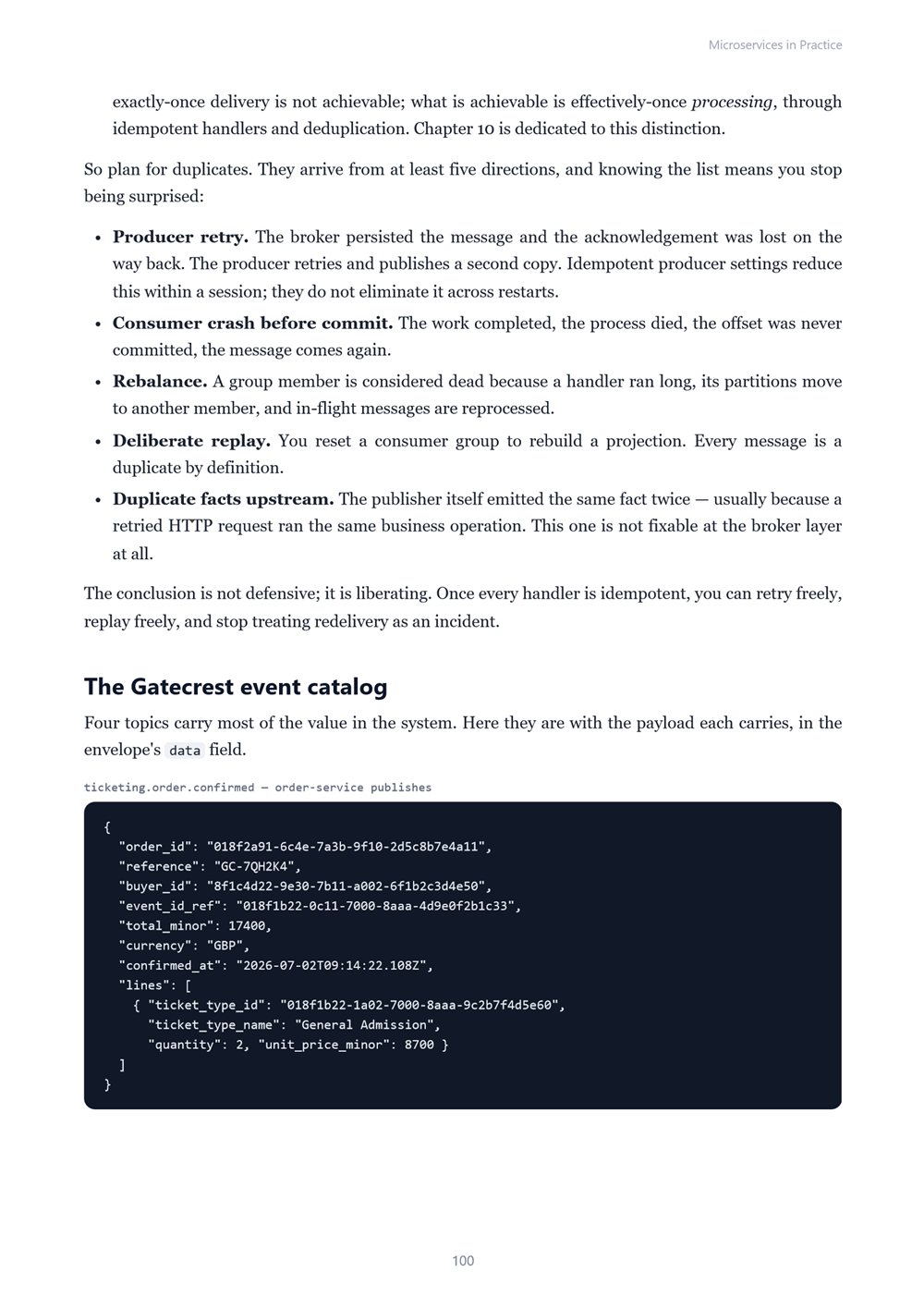
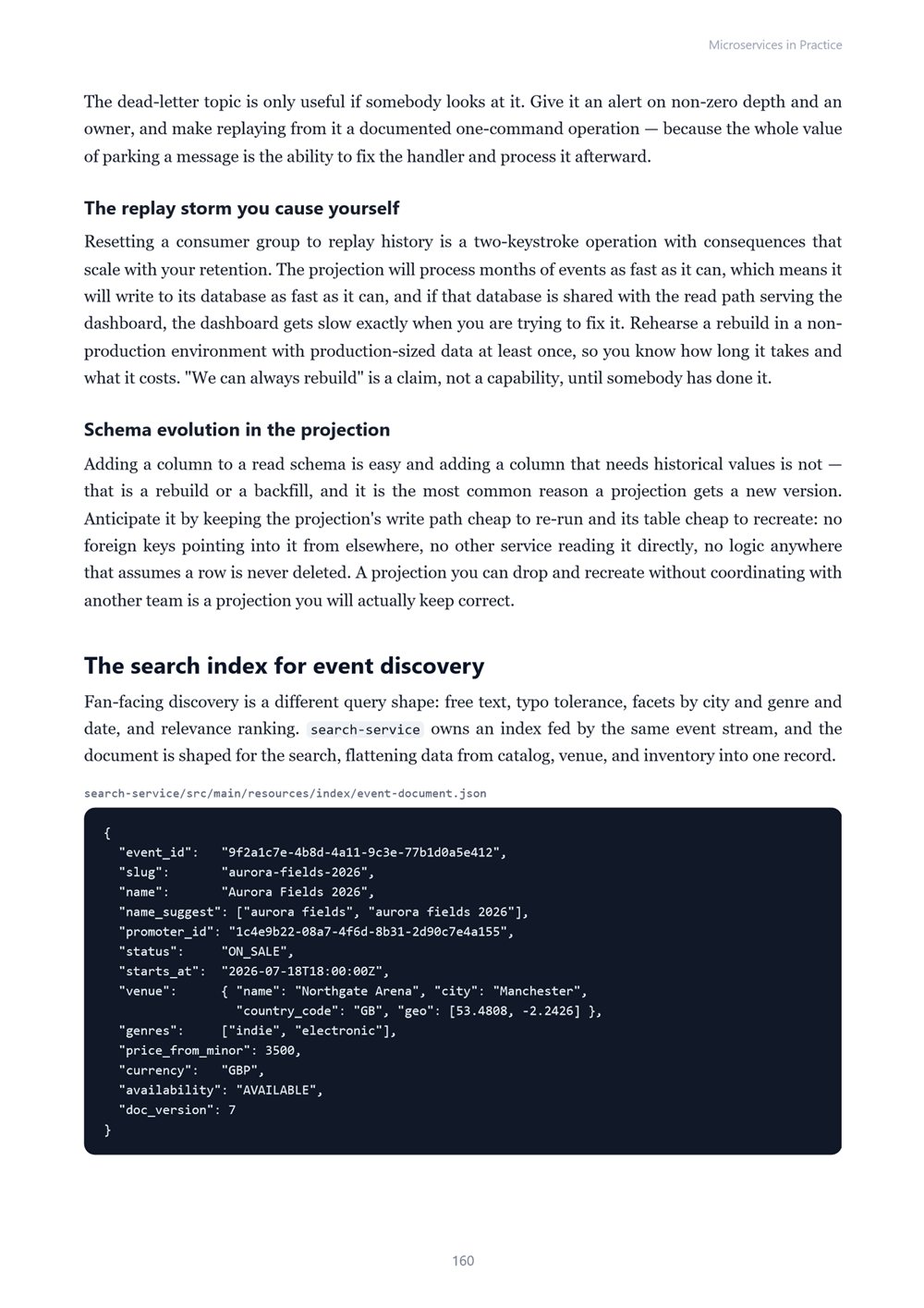
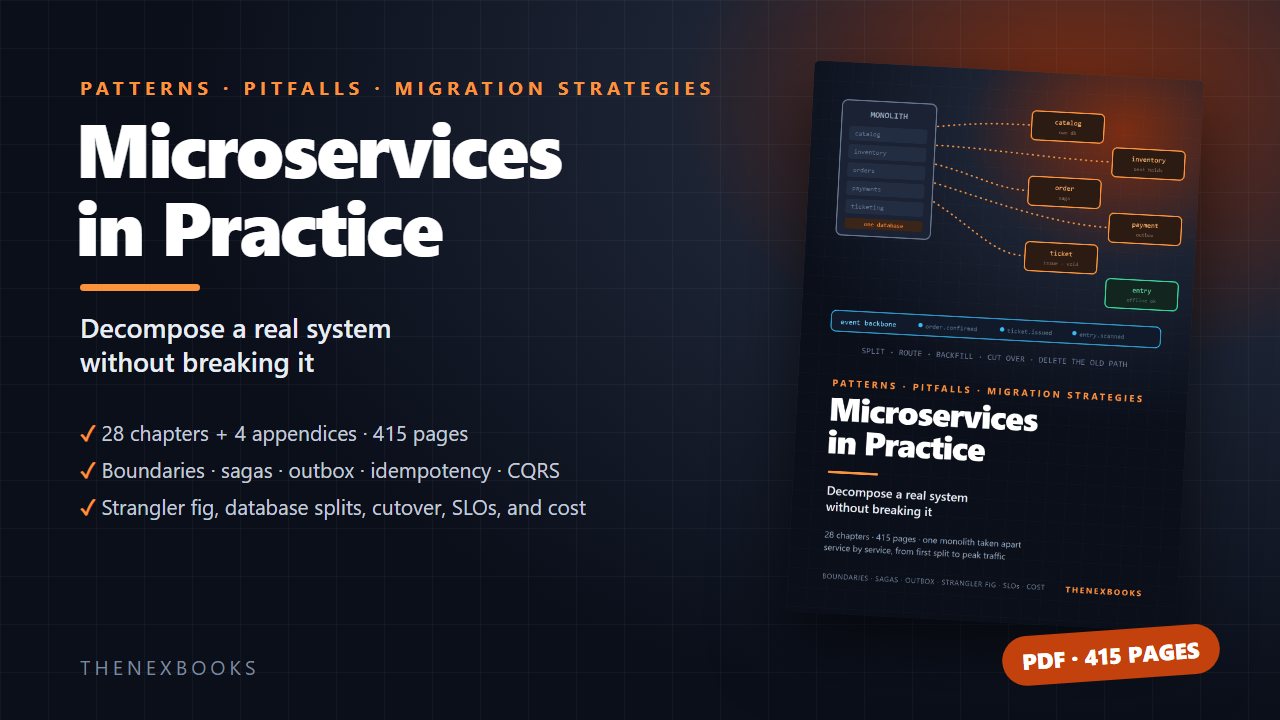
A 415-page practical guide to microservices — deciding whether to split at all, finding boundaries that hold, and migrating a live monolith service by service without breaking it.
Patterns, Pitfalls, and Migration Strategies
Read before you buy: the PDF here is a free sample — the first 20 pages of the 415-page book (payments, sales and reviews on this demo site are sample data). Get the full e-book at thenexbooks on Gumroad.
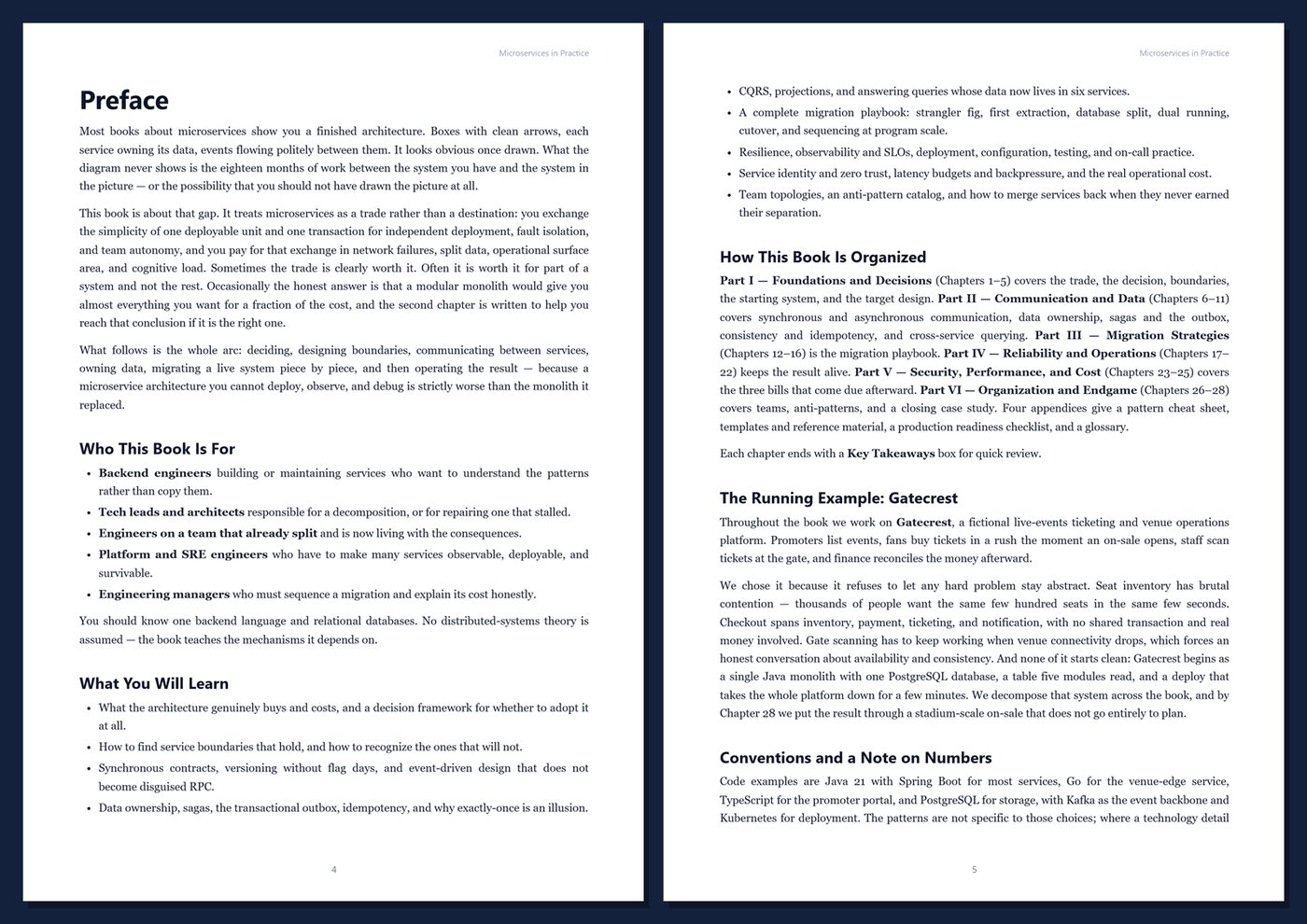
Most microservices books show you the finished architecture. Clean boxes, polite arrows, every service owning its data. What the diagram never shows is the eighteen months between the system you have and the system in the picture — or the possibility that you should not have drawn the picture at all.
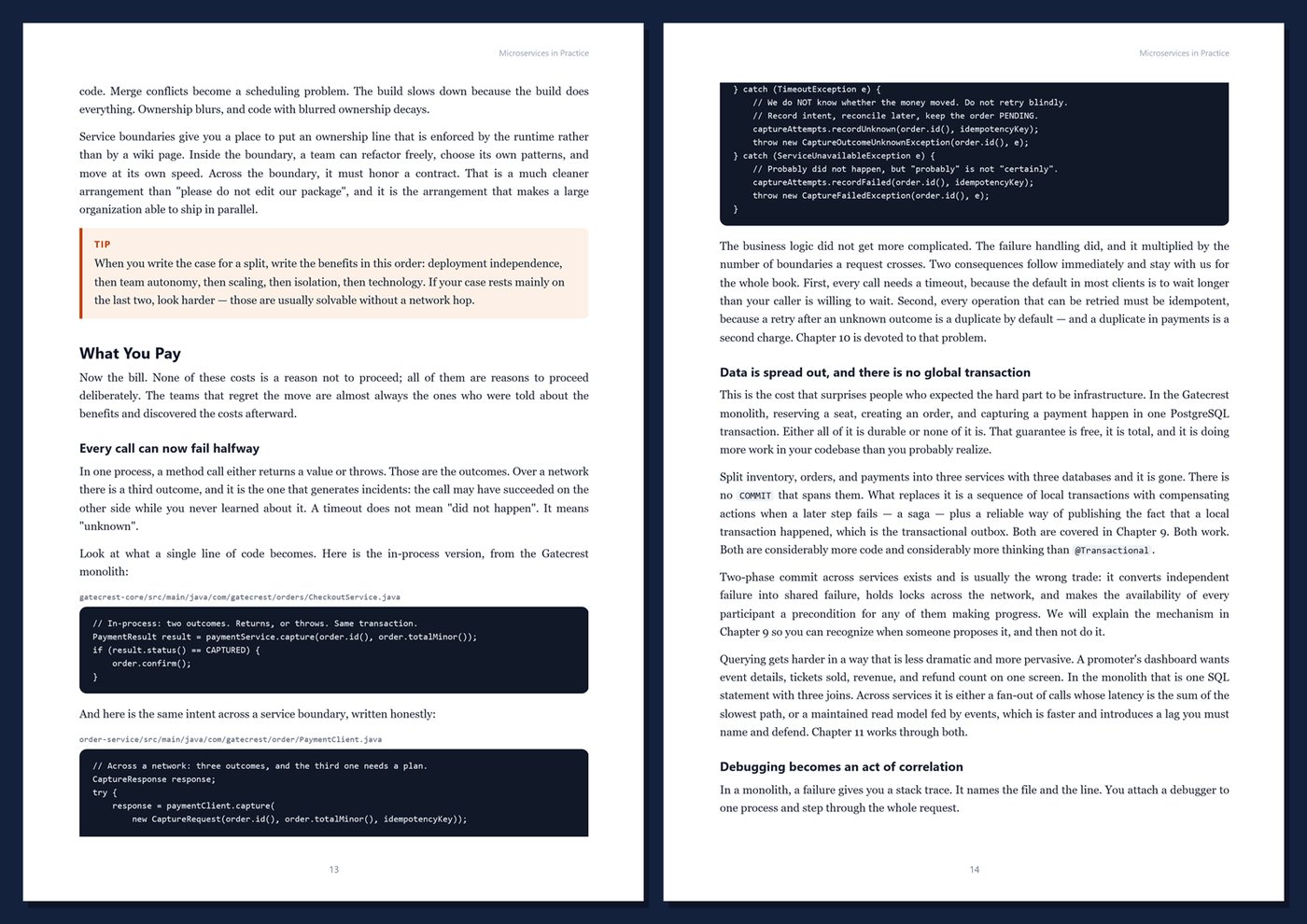
This book is about that gap. It treats microservices as a trade, not a destination: you exchange one deployable unit and one transaction for independent deployment, fault isolation, and team autonomy, and you pay in network failures, split data, operational surface area, and cognitive load. Chapter 2 is written to help you decide not to split, if that is the right answer.
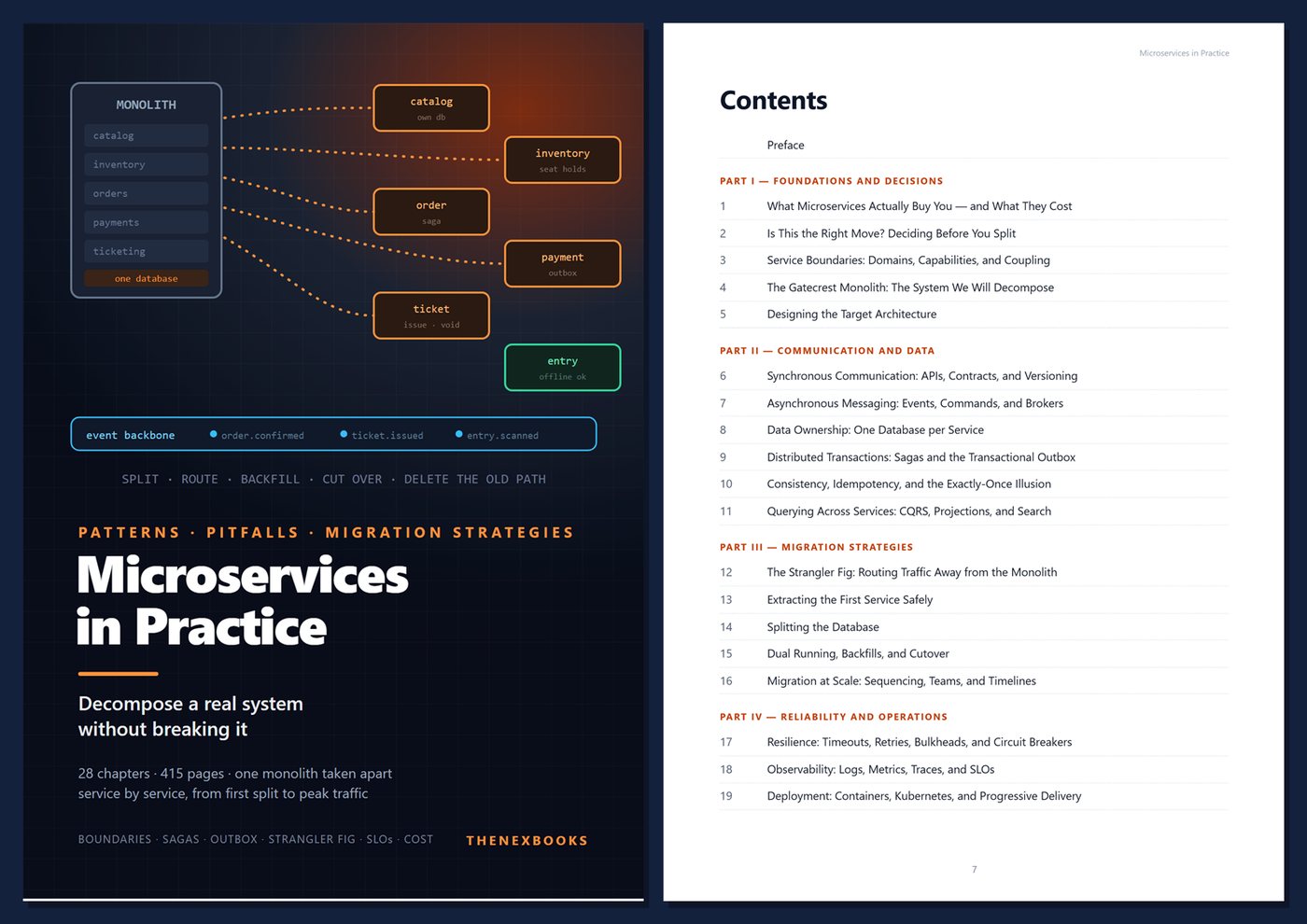
Everything is worked on one realistic system: Gatecrest, a live-events ticketing and venue operations platform that starts as a single Java monolith with one PostgreSQL database, a table five modules read, and a deploy that takes the whole platform down. Seat inventory has brutal contention, checkout spans four services with real money involved, and gate scanning has to keep working when venue connectivity drops. We take it apart across the book and, in Chapter 28, put the result through a stadium-scale on-sale that does not go entirely to plan.
- 415 pages · 28 chapters + 4 appendices
- A decision framework for whether to adopt microservices at all — including when a modular monolith wins
- Finding service boundaries that hold, and recognizing the ones that will not
- Synchronous contracts and versioning without flag days; events that do not become disguised RPC
- Data ownership, sagas, the transactional outbox, idempotency, and why exactly-once is an illusion
- CQRS, projections, and querying data that now lives in six services
- A complete migration playbook: strangler fig, first extraction, database split, dual running, cutover
- Sequencing a migration at program scale — teams, timelines, and what to do when it stalls
- Resilience, observability and SLOs, progressive delivery, config and secrets, testing, and on-call
- Service identity and zero trust, latency budgets and backpressure, and the real operational bill
- Team topologies, an anti-pattern catalog, and how to merge services back when they never earned separation
- No benchmarks, no cost-savings claims, no adoption statistics — every number is Gatecrest's own budget or a blank for your measurements
Table Of Contents
Part I — Foundations and Decisions
- Ch 1 · What Microservices Actually Buy You — and What They Cost
- Ch 2 · Is This the Right Move? Deciding Before You Split
- Ch 3 · Service Boundaries: Domains, Capabilities, and Coupling
- Ch 4 · The Gatecrest Monolith: The System We Will Decompose
- Ch 5 · Designing the Target Architecture
Part II — Communication and Data
- Ch 6 · Synchronous Communication: APIs, Contracts, and Versioning
- Ch 7 · Asynchronous Messaging: Events, Commands, and Brokers
- Ch 8 · Data Ownership: One Database per Service
- Ch 9 · Distributed Transactions: Sagas and the Transactional Outbox
- Ch 10 · Consistency, Idempotency, and the Exactly-Once Illusion
- Ch 11 · Querying Across Services: CQRS, Projections, and Search
Part III — Migration Strategies
- Ch 12 · The Strangler Fig: Routing Traffic Away from the Monolith
- Ch 13 · Extracting the First Service Safely
- Ch 14 · Splitting the Database
- Ch 15 · Dual Running, Backfills, and Cutover
- Ch 16 · Migration at Scale: Sequencing, Teams, and Timelines
Part IV — Reliability and Operations
- Ch 17 · Resilience: Timeouts, Retries, Bulkheads, and Circuit Breakers
- Ch 18 · Observability: Logs, Metrics, Traces, and SLOs
- Ch 19 · Deployment: Containers, Kubernetes, and Progressive Delivery
- Ch 20 · Configuration, Secrets, and Environments
- Ch 21 · Testing Microservices: Contracts, Components, and Chaos
- Ch 22 · Running in Production: On-Call, Incidents, and Postmortems
Part V — Security, Performance, and Cost
- Ch 23 · Security: Identity, Service-to-Service Auth, and Zero Trust
- Ch 24 · Performance: Latency Budgets, Caching, and Backpressure
- Ch 25 · Cost and Efficiency: What Microservices Really Spend
Part VI — Organization and Endgame
- Ch 26 · Teams, Ownership, and Conway's Law in Practice
- Ch 27 · Anti-Patterns and When to Merge Services Back
- Ch 28 · Case Study: Gatecrest Through a Peak On-Sale
Appendices
- App A · Pattern Cheat Sheet
- App B · Templates and Reference
- App C · Production Readiness Checklist
- App D · Glossary
WHO IT IS FOR
Backend engineers building or maintaining services who want to understand the patterns rather than copy them, tech leads and architects responsible for a decomposition or for repairing one that stalled, teams already living with the consequences of a split, platform and SRE engineers who must make many services observable and survivable, and engineering managers who need to sequence a migration and explain its cost honestly. You should know one backend language and relational databases; no distributed-systems theory is assumed.
FORMAT
PDF (A4), 415 pages, English, clickable table of contents and PDF bookmarks. 1st Edition, 2026. Published by thenexbooks.
A NOTE ON NUMBERS
This book contains no benchmarks, latency measurements, cost savings, or adoption statistics. Those figures depend on workload, hardware, and configuration to the point where quoting them is misleading. Where a number appears, it is Gatecrest's own budget or a blank for you to fill in from your own measurements.
Code examples use Java 21 with Spring Boot, Go for the venue-edge service, TypeScript for the promoter portal, PostgreSQL for storage, Kafka as the event backbone, and Kubernetes for deployment — but the patterns are not specific to those choices. This book is independent and is not affiliated with or endorsed by any of the projects, foundations, or vendors it names.
Book details
| Detail | |
|---|---|
| Pages | 415 |
| Format | PDF (A4) |
| Language | English |
| Level | Intermediate to Advanced |
| Edition | 1st Edition, 2026 |
| Download on this site | Free sample, first 20 pages (PDF) |
| Publisher | thenexbooks |
Files you get
No reviews yet. Only buyers can review.
More from thenexbooks