 1 / 11
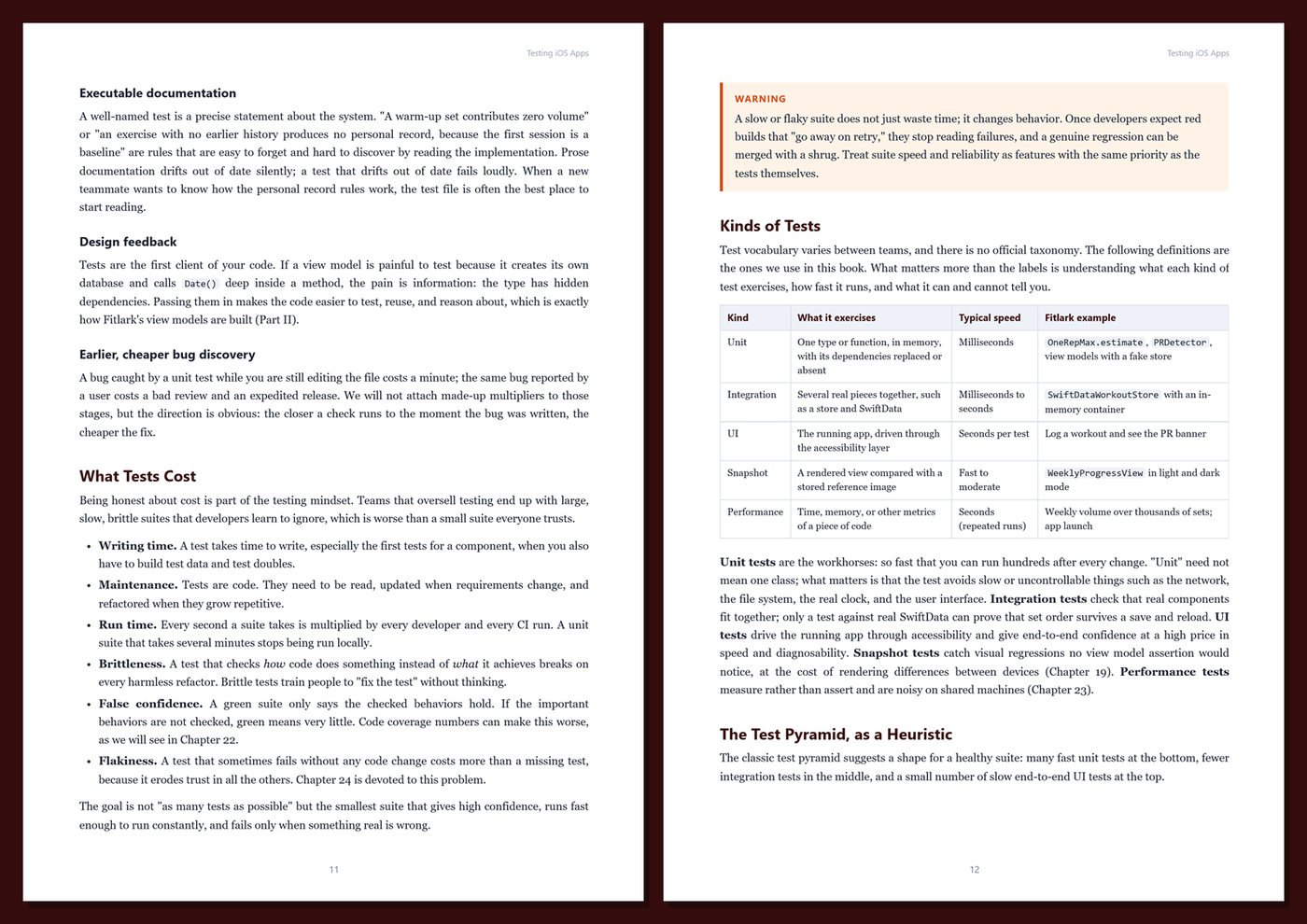
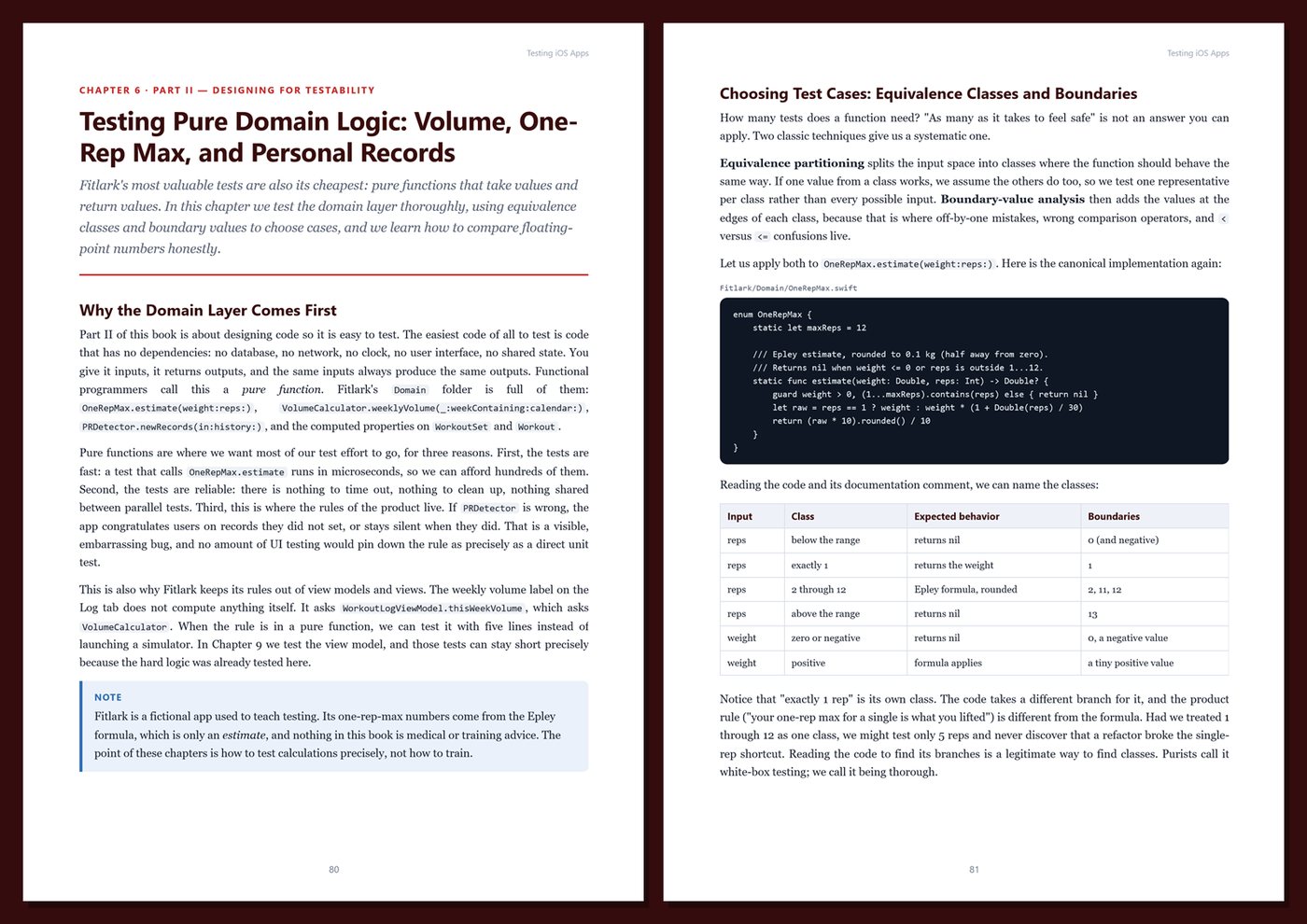
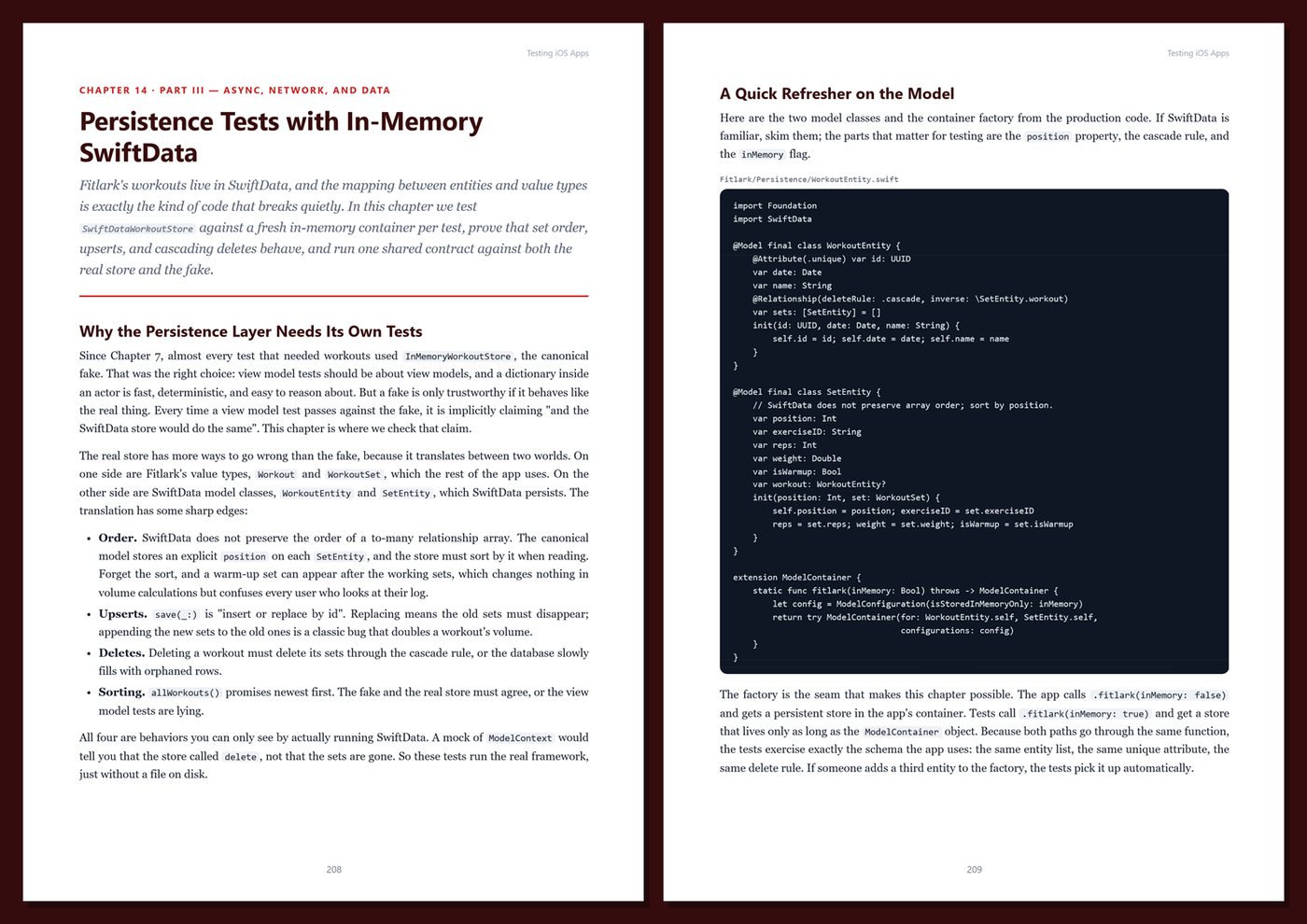
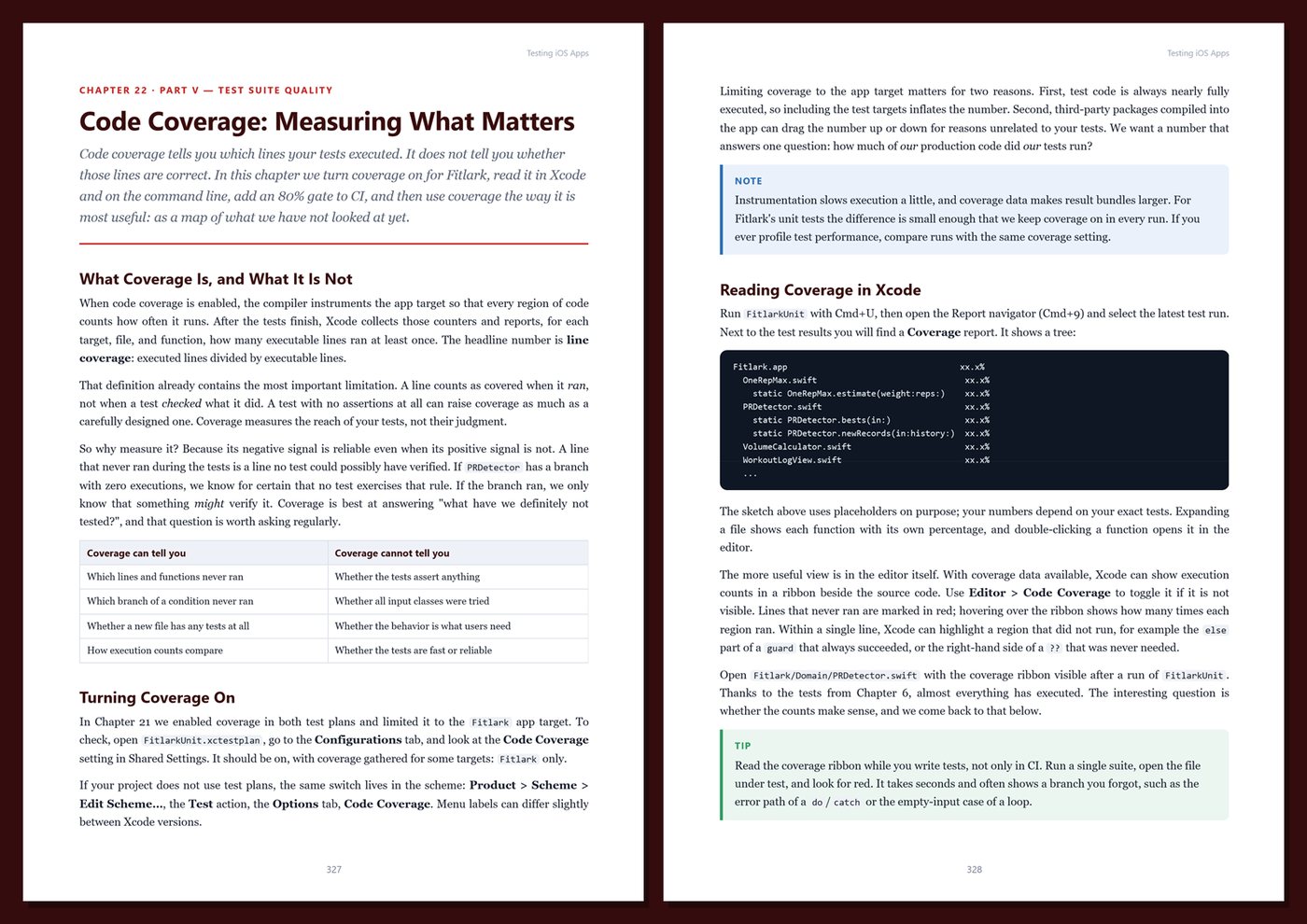
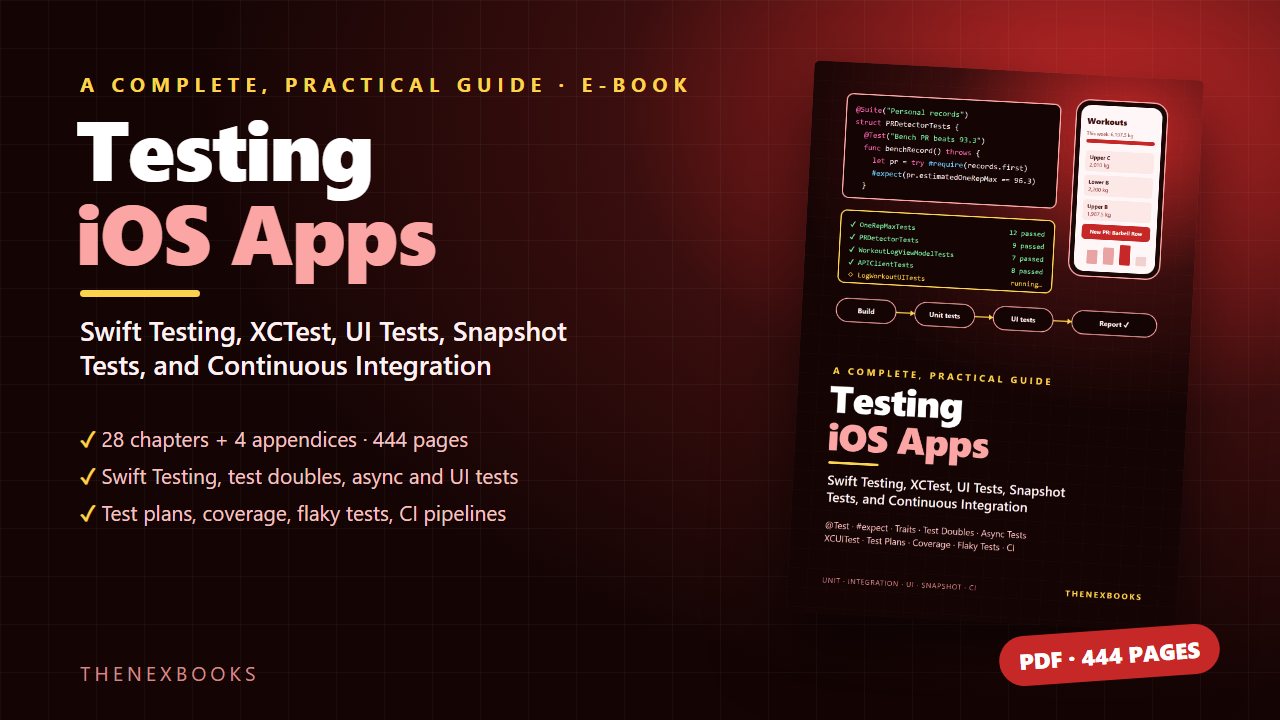
Build a fast, trustworthy test suite for your iOS app: the testing mindset and test pyramid, Swift Testing in depth (@Test, #expect, #require, traits, tags, parameterized and async tests, confirmations), XCTest and migration, test doubles and dependency injection, Observation view models…
Swift Testing, XCTest, UI Tests, Snapshot Tests, and Continuous Integration
Read before you buy: the PDF here is a free sample — the first 20 pages of the 444-page book (payments, sales and reviews on this demo site are sample data). Get the full e-book at thenexbooks on Gumroad.
Stop fighting your tests. Build a suite that is fast, honest, and trusted on every pull request.
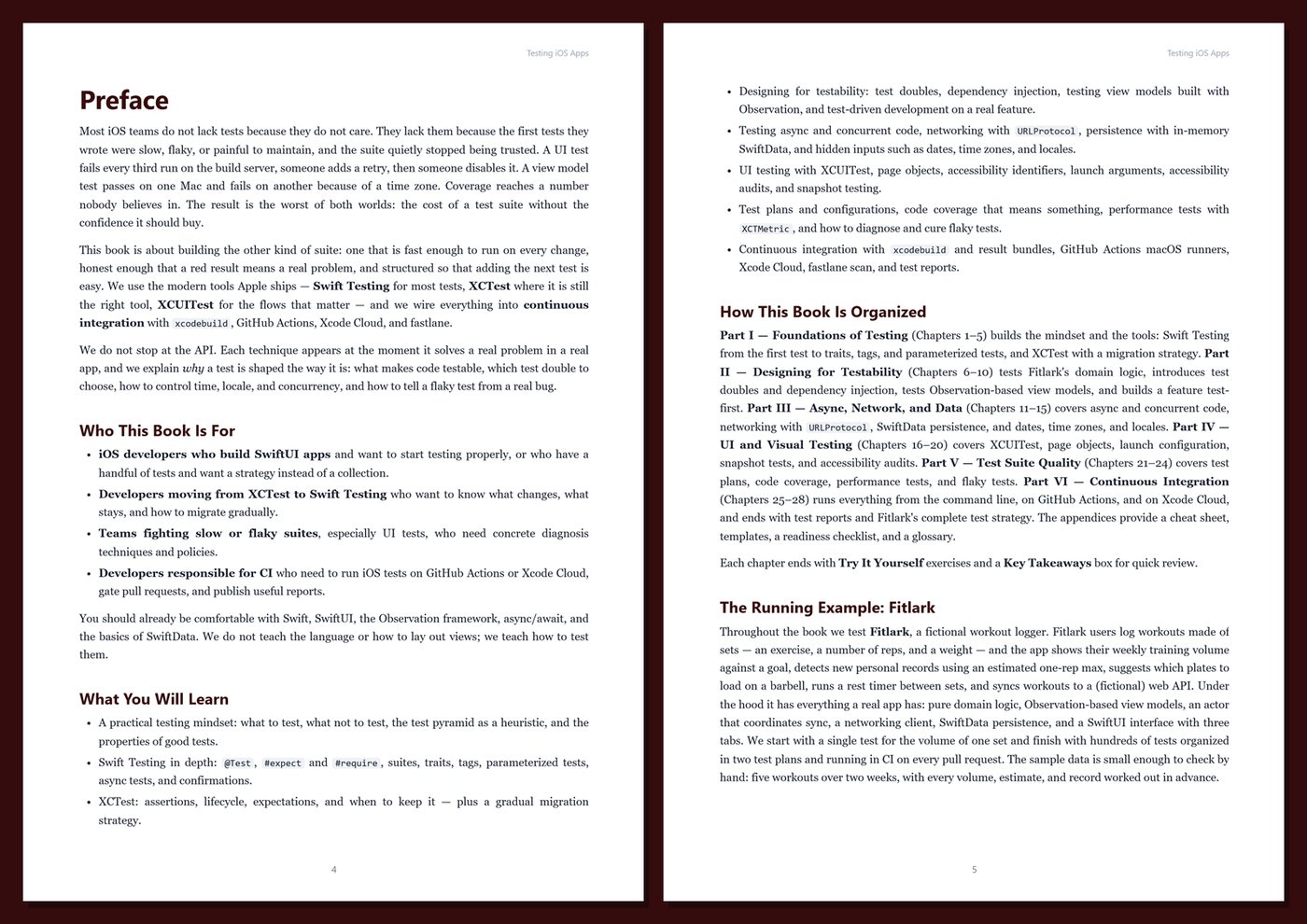
Most iOS teams do not lack tests because they do not care. They lack them because the first tests were slow, flaky, or painful to maintain, and the suite quietly stopped being trusted. A UI test fails every third run on CI, a view model test breaks in another time zone, and coverage reaches a number nobody believes.
This book shows you how to build the other kind of suite. You use the modern tools — Swift Testing for most tests, XCTest where it is still the right tool, XCUITest for the flows that matter — and wire everything into continuous integration. Every technique appears at the moment it solves a real problem in a real app, and every chapter explains why a test is shaped the way it is.
What's inside
- The testing mindset: what to test and what not to, the test pyramid as a heuristic, and the properties of good tests
- Swift Testing in depth: @Test, #expect and #require, error testing, suites, traits, tags, parameterized tests, async tests, and confirmations
- XCTest: assertions, lifecycle, expectations, what must stay in XCTest, and a gradual migration strategy
- Testable design: test doubles (stubs, fakes, spies, mocks), dependency injection with protocols, closures, and the environment
- Testing view models built with Observation, and a complete feature built test-first with TDD
- Async and concurrent code: actors, MainActor, cancellation, and controlling time without sleeps
- Networking tests with URLProtocol, persistence tests with in-memory SwiftData, and pinning hidden inputs such as dates, time zones, and locales
- UI tests with XCUITest, page objects, accessibility identifiers, launch arguments, seeded test data, and accessibility audits
- Snapshot testing SwiftUI views, with the trade-offs explained
- Test plans and configurations, code coverage that informs instead of misleads, and performance tests with XCTMetric
- Flaky tests: systematic diagnosis, quarantine policies, and real cures
- Continuous integration: xcodebuild and result bundles, GitHub Actions macOS runners, Xcode Cloud, fastlane scan, and readable test reports
One running example, start to finish. You build the test suite for Fitlark, a fictional workout logger with exercises, sets, personal records, weekly training volume, a plate calculator, a rest timer, and sync to a web API. It has everything a real app has — domain logic, Observation view models, an actor that coordinates sync, a networking client, SwiftData persistence, and a three-tab SwiftUI interface. The sample data is small enough to check by hand, and every expected value in the tests is worked out in advance.
Current and honest. The book uses the Swift 6 language mode, Xcode 26-era tooling, and an iOS 18 deployment target, with newer features clearly marked. It contains no invented benchmarks or statistics, and it never quotes CI prices that may change. Test output and logs are shown as output similar to what you will see. Every chapter includes complete code, Tips, Notes, Warnings, exercises, and Key Takeaways, and the appendices give you a cheat sheet, copy-ready templates, a test-suite and CI readiness checklist, and a glossary.
Format: PDF, 444 pages (A4), linked table of contents and bookmarks. English. First Edition, 2026. Published by thenexbooks. Requires a Mac with Xcode to run the examples. This book is independent and is not affiliated with, sponsored by, or endorsed by Apple Inc. or GitHub, Inc.
Table of Contents
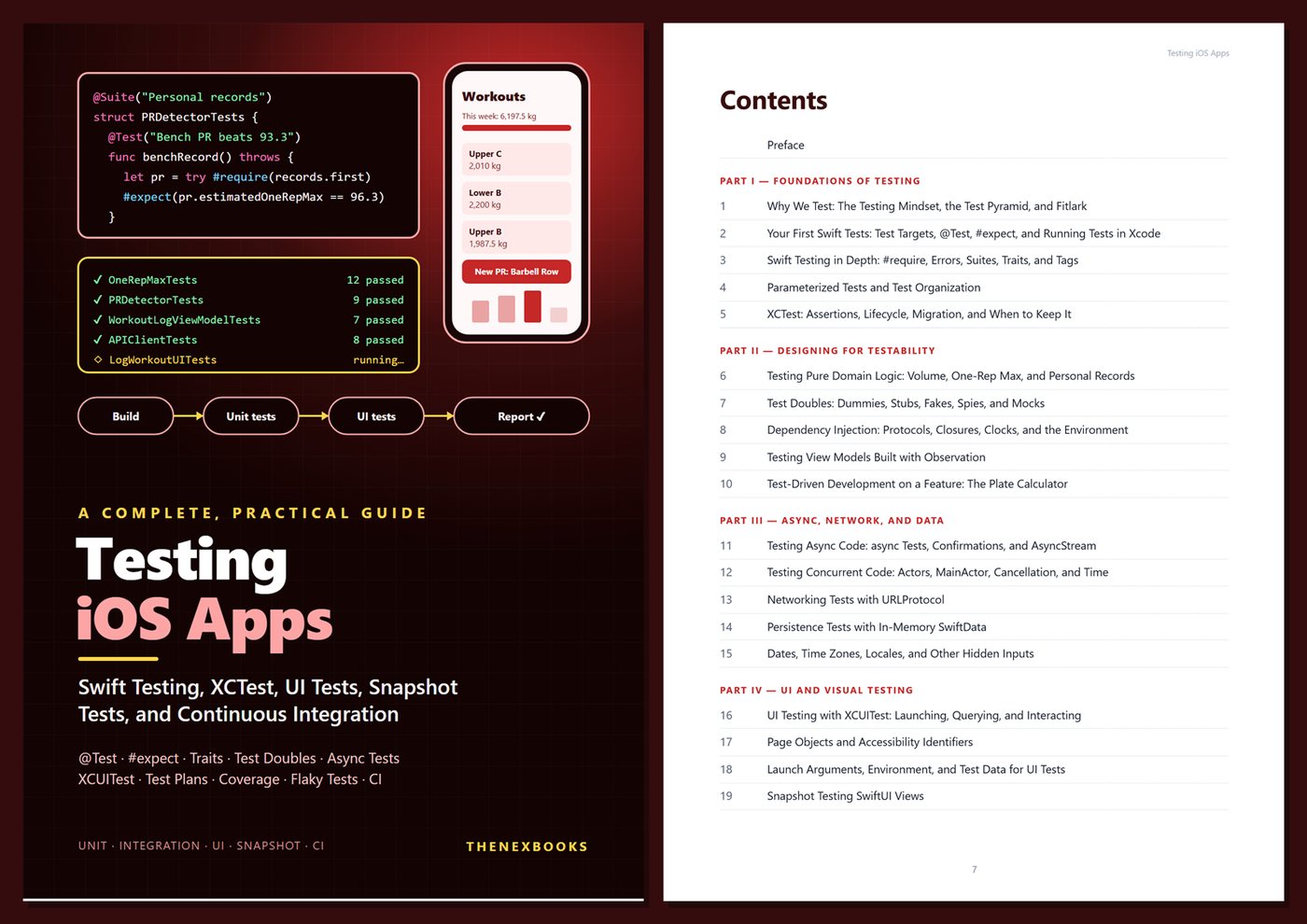
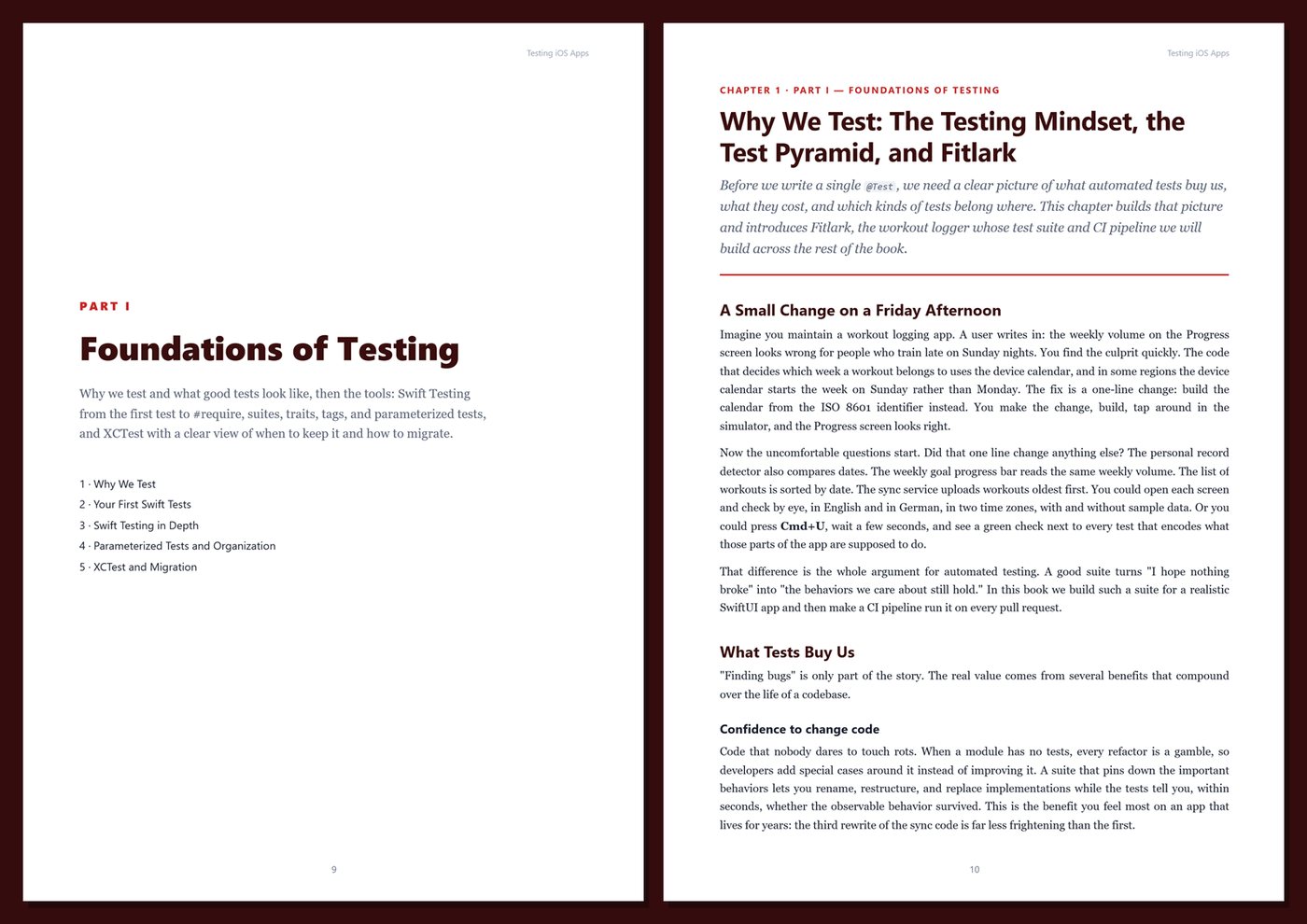
Part I — Foundations of Testing
- Ch 1 · Why We Test: The Testing Mindset, the Test Pyramid, and Fitlark
- Ch 2 · Your First Swift Tests: Test Targets, @Test, #expect, and Running Tests in Xcode
- Ch 3 · Swift Testing in Depth: #require, Errors, Suites, Traits, and Tags
- Ch 4 · Parameterized Tests and Test Organization
- Ch 5 · XCTest: Assertions, Lifecycle, Migration, and When to Keep It
Part II — Designing for Testability
- Ch 6 · Testing Pure Domain Logic: Volume, One-Rep Max, and Personal Records
- Ch 7 · Test Doubles: Dummies, Stubs, Fakes, Spies, and Mocks
- Ch 8 · Dependency Injection: Protocols, Closures, Clocks, and the Environment
- Ch 9 · Testing View Models Built with Observation
- Ch 10 · Test-Driven Development on a Feature: The Plate Calculator
Part III — Async, Network, and Data
- Ch 11 · Testing Async Code: async Tests, Confirmations, and AsyncStream
- Ch 12 · Testing Concurrent Code: Actors, MainActor, Cancellation, and Time
- Ch 13 · Networking Tests with URLProtocol
- Ch 14 · Persistence Tests with In-Memory SwiftData
- Ch 15 · Dates, Time Zones, Locales, and Other Hidden Inputs
Part IV — UI and Visual Testing
- Ch 16 · UI Testing with XCUITest: Launching, Querying, and Interacting
- Ch 17 · Page Objects and Accessibility Identifiers
- Ch 18 · Launch Arguments, Environment, and Test Data for UI Tests
- Ch 19 · Snapshot Testing SwiftUI Views
- Ch 20 · Accessibility Audits and Testing Across Languages and Appearances
Part V — Test Suite Quality
- Ch 21 · Test Plans, Configurations, and Schemes
- Ch 22 · Code Coverage: Measuring What Matters
- Ch 23 · Performance Tests with XCTMetric
- Ch 24 · Flaky Tests: Diagnosis, Quarantine, and Cures
Part VI — Continuous Integration
- Ch 25 · Command-Line Testing with xcodebuild and Result Bundles
- Ch 26 · GitHub Actions on macOS Runners
- Ch 27 · Xcode Cloud and fastlane scan
- Ch 28 · Test Reports and Case Study: Fitlark's Complete Test Strategy
Appendices
A · Testing Cheat Sheet
B · Templates and Reference
C · Test Suite and CI Readiness Checklist
D · Glossary
Book details
| Detail | |
|---|---|
| Pages | 444 |
| Format | PDF (A4) |
| Language | English |
| Level | Intermediate |
| Edition | 1st Edition (2026) |
| Download on this site | Free sample, first 20 pages (PDF) |
| Publisher | thenexbooks |
Files you get
No reviews yet. Only buyers can review.
More from thenexbooks